
Chengdu, Sichuan, China – October 24, 2026
Honestly? Picking an Oxygen Analyzer isn’t just a simple spec exercise. It’s a risk decision—plain and simple.If you’re buying oxygen sensors for global projects, you might be dealing with medical plants, metal cutting lines, wastewater systems, or even electrolyzer setups. And honestly, every one of those applications shifts what you need—range, accuracy, response time, and how you handle alarms. According to the World Health Organization’s Technical Specifications for Oxygen Concentrators, concentrator output usually lands somewhere between 82% and 96% oxygen. So that range is what makes sensor selection a practical call, not just a theoretical one. You know, a device that’s built for trace oxygen? It might not do so great when you put it in a high-concentration stream.Honestly, when you’re choosing an oxygen analyzer, start with your process conditions. You’ll want to check pressure, temperature, humidity, contaminants, flow, and the oxygen concentration you expect. Different types—paramagnetic, zirconia, electrochemical, and laser-based—don’t all behave the same way. And the National Institute of Standards and Technology (NIST) really stresses traceability, which means using calibrated standards and evaluating uncertainty. If you’re buying for a regulated facility, it’s worth checking a few things: ISO 17025 calibration capability, ISO 8573 requirements, and whatever local electrical safety approvals apply. Certifications definitely matter—but they’re not a substitute for good engineering judgment.So, reports from the International Energy Agency—like the Global Hydrogen Review 2024—point to ongoing investment in hydrogen and electrolyzer capacity. And as that grows? Well, it means more demand for reliable oxygen monitoring around production, separation, and ventilation systems. On top of that, the United States Pharmacopeia’s oxygen quality requirements serve as a reminder to medical-gas buyers: you’ve got to document your purity evidence. When you’re choosing an Oxygen Gas Analyzer, look for a few practical things: clear calibration records, stable sampling, fast alarms, and service that’s actually easy to reach. And yeah — ask for real test data, not just the accuracy numbers from a brochure. No analyzer is perfect, of course. Even seasoned teams can miss things like humidity issues or a leak in the sample line. Also, that low purchase price? It can get expensive fast once sensors start drifting or spare parts have to cross borders. So, basically, this guide is here to help buyers around the world make a decision they can actually stand behind.
 Oxygen Analyzer Basics: What It Measures and Why It MattersHow to Choose an Oxygen Analyzer for Global Buyers?
An Oxygen Analyzer measures the amount of oxygen in a gas stream. The result is commonly shown as a percentage, parts per million, or trace-level reading. This measurement supports safer combustion, controlled packaging, medical gas verification, and industrial process control. A small reading can reveal a serious problem.
The measurement principle matters. Zirconia sensors suit high-temperature applications, while electrochemical sensors often fit portable systems. Paramagnetic technology can provide stable readings in clean, dry gas.
Moisture, pressure, temperature, and background gases may influence accuracy. In field commissioning, I check the sample line first. A cracked tube can imitate sensor failure.
Buyers should review the required range, response time, alarm settings, and calibration method. Ask whether the analyzer compensates for pressure changes. Confirm the stated accuracy under real operating conditions, not only in a laboratory. Documentation should include calibration records, maintenance intervals, and safety instructions. Local service access also matters for global projects. I have seen teams choose impressive specifications, then struggle with spare parts. That mistake is easy to repeat. A practical review of sample handling, installation space, and operator training often produces a better choice.
Define Your Application, Gas Conditions, and Measurement Goals
Choosing an oxygen analyzer starts with the application, not the product brochure. A Fuel Cell Oxygen Analyzer may suit monitoring in clean, dry gas streams, while harsh process gases may require another sensing method. Define where measurement occurs: laboratory bench, pipeline, furnace, medical system, or fuel-cell test station. Each location creates different demands.Describe the gas conditions precisely. Record oxygen concentration, pressure, temperature, humidity, flow rate, and possible contaminants. Sulfur compounds, solvents, and dust can shorten sensor life or distort readings. I have seen buyers focus on the measurement range and overlook pressure changes. That mistake can produce unstable results. Think about installation space, sampling lines, and maintenance access, too.Tips: Write the target range first. Then specify accuracy, response time, alarm limits, and output signals. Ask whether calibration gases are available locally and whether technicians can verify performance. A fast response is useful for changing gas streams, but stability may matter more during long production cycles. Do not assume “higher accuracy” solves every problem. Sometimes poor sampling causes larger errors than the analyzer itself. Test the complete sampling setup before approval. Review the first results critically; unexpected readings may reveal leaks, moisture, or an unsuitable measurement goal.
How to Choose an Oxygen Analyzer for Global Buyers?
Define your application, gas conditions, and measurement goals before selecting the sensor technology, measuring range, response time, and required accuracy.
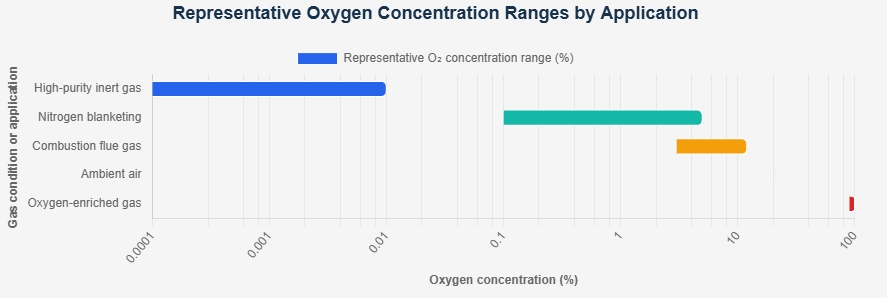
The chart shows representative oxygen concentration ranges encountered in common applications. Low-oxygen inerting and high-purity gas service require analyzers with strong sensitivity and low detection limits, while combustion and oxygen-enriched processes require wider ranges and materials compatible with the gas conditions. Actual specifications should be confirmed against process pressure, humidity, temperature, contaminants, and the required measurement accuracy.
Compare Oxygen Sensor Technologies and Operating Principles
How to Choose an Oxygen Analyzer for Global Buyers?The sensor principle matters more than a polished specification sheet. Paramagnetic analyzers measure oxygen’s magnetic susceptibility. They provide stable, non-consumable measurement for clean process gas, but pressure changes can affect accuracy. Zirconia sensors measure oxygen through a high-temperature electrochemical reaction. They respond quickly across wide ranges, yet require heating and careful sample conditioning.
Electrochemical sensorsuse a galvanic cell. They are compact and economical, but their electrolyte gradually wears out. Humidity, temperature, and acidic contaminants can shorten service life.
Laser analyzersmeasure oxygen absorption at a selected wavelength. They offer fast response and low maintenance, especially in dry gas streams, although optical windows need protection.
Do not treat “maintenance-free” as a complete claim.
The International Energy Agency’s Global Hydrogen Review 2024 reported about 1.4 GW of installed electrolyzer capacity worldwide at the end of 2023. This growth increases demand for oxygen monitoring around hydrogen production and gas separation. For medical applications, the WHO-UNICEF technical specifications commonly reference oxygen concentrator output around 82–96% purity. That range shows why analyzer resolution and calibration stability matter.
A process engineer should check sample pressure, moisture, expected oxygen range, response time, and calibration gases before choosing. Field installation is often messier than laboratory testing. I would also question a very low purchase price. A cheap sensor may create more downtime than savings.
Match Accuracy, Range, Response Time, and Stability Requirements
Choosing an oxygen analyzer starts with the measurement task, not the catalog. OSHA defines oxygen-deficient atmospheres below 19.5% and oxygen-enriched atmospheres above 23.5% by volume. These limits make accuracy a safety parameter, not a marketing detail. For routine ambient monitoring, a ±0.5% reading may be sufficient. Process control can demand tighter performance. Confirm the calibration gas, measurement uncertainty, and traceability to ISO/IEC 17025 laboratories.
Range must match the real process window. A sensor designed for ambient air may fail in inerting, combustion, or high-purity gas service. Review the lowest and highest expected oxygen levels, including startup conditions. Response time matters near rapid transitions. A five-second response can protect a changing process better than a slower instrument with impressive laboratory accuracy. Yet response time often depends on tubing length, flow rate, and sample conditioning.
Stability is less visible but equally important. Drift forces frequent calibration and weakens confidence between inspections. Ask for zero and span drift data over a stated period, such as 30 or 90 days. IEC 61508 can guide discussions about functional safety, but it does not automatically prove analyzer suitability. A published specification is useful evidence, not final proof. In practice, many selection mistakes come from testing the analyzer alone, rather than the complete sampling system. Recheck that assumption.
Evaluate Installation, Calibration, Maintenance, and Safety Features
Choosing an Industrial Oxygen Analyzer starts with the installation environment, not the catalog page. Confirm sample temperature, pressure, moisture, dust, and expected oxygen range. A hot, wet line can distort readings before the sensor even responds. Place the sampling point near the process risk, while keeping the analyzer accessible for inspection. U.S. OSHA’s Technical Manual defines oxygen-deficient air as below 19.5% and oxygen-enriched air as above 23.5%. These limits should shape alarm settings, ventilation checks, and shutdown logic.
Calibration needs traceable gases, documented procedures, and realistic intervals. NIST measurement guidance supports linking calibration results to national standards, rather than relying on an undocumented “zero” adjustment. Field technicians should record gas concentration, cylinder identification, ambient conditions, response time, and final error. Small details matter. A sensor reading 0.4% high may appear harmless, but it can alter an inerting decision. Maintenance plans should include filter replacement, tubing inspections, leak checks, and sensor-life tracking. IEC 60079-29-2 guidance also emphasizes correct detector placement, functional testing, and periodic verification in hazardous areas. Still, fixed schedules are imperfect. Process changes, vibration, condensation, and frequent exposure can shorten service intervals. Review the trend data honestly, especially after a near miss or unexplained alarm.
Check Certifications, Total Cost, Support, and Global Availability
For global buyers, certification is the first filter, not a decorative certificate. Check IEC 61010 safety compliance, relevant electromagnetic compatibility testing, and an ISO/IEC 17025 calibration report. Ask whether the certificate covers the exact Handheld Oxygen Analyzer model. A copied test report creates risk. The 2024 World Bank Logistics Performance Index rates customs and delivery reliability on a one-to-five scale, showing why documentation matters across borders.Compare total cost, not only the purchase price. Include sensor replacement, calibration gases, batteries, software, shipping, import duties, and technician time. A low-cost unit can become expensive after repeated sensor changes. The Global E-waste Monitor 2024 reported 62 million tonnes of electronic waste in 2022. Longer sensor life and repairable parts can reduce both operating waste and replacement pressure. Still, projected savings may look better on paper than in a dusty plant.Support is practical evidence of supplier competence. Request response times, spare-parts availability, calibration procedures, and training records. Confirm local service coverage before payment. A clear English manual is useful, but a reachable technician is better. Check whether the instrument can be shipped legally to your destination and supported after warranty expiration. Some buyers overlook this detail. I have seen purchasing teams compare specifications for hours, then ignore a six-month parts delay. Global availability should mean dependable stock, traceable logistics, and realistic delivery dates—not a promise on a webpage.
How to Choose an Oxygen Analyzer for Global Buyers? – Check Certifications, Total Cost, Support, and Global Availability
| Evaluation Dimension | Typical Requirement or Benchmark | What to Verify Before Purchase | Global Buying Impact | Recommended Decision Rule |
|---|---|---|---|---|
| Measurement Technology | Electrochemical, paramagnetic, zirconia, or laser-based measurement, selected according to gas composition, concentration, temperature, and process conditions. | Confirm cross-sensitivity, sample conditioning requirements, humidity tolerance, and compatibility with corrosive or combustible gases. | The technology affects sensor life, calibration frequency, shipping restrictions, and maintenance skills required in each country. | Choose the simplest technology that meets the required accuracy and process conditions. |
| Measurement Range | Common ranges include trace oxygen from parts per million to percent-level measurement, and 0–100% oxygen for process or purity monitoring. | Check the specified range, resolution, turndown ratio, over-range protection, and whether the accuracy applies across the full range. | A wider range may reduce the need for multiple instruments but can increase calibration and sensor replacement costs. | Select a range that covers the normal operating point near the middle of the calibrated span. |
| Accuracy and Repeatability | Typical general-purpose analyzers may provide approximately ±0.5% oxygen by volume; higher-performance systems may achieve approximately ±0.1% of full scale or better, depending on technology and conditions. | Determine whether accuracy is stated as percent of reading, percent of full scale, or absolute concentration, and review temperature and pressure effects. | Incorrect interpretation of accuracy can cause non-compliance, rejected product, or unnecessary process adjustments. | Compare full-scale accuracy and repeatability using the same units and operating conditions. |
| Response Time | Many process analyzers provide a response time from a few seconds to approximately one minute, depending on sample tubing, filters, flow rate, and sensor technology. | Ask for T90 response time under actual sample-system conditions rather than sensor-only response time. | Long sample lines and unsuitable filters can make a fast analyzer behave slowly at the installation site. | Specify the maximum acceptable alarm and control delay before requesting quotations. |
| Calibration and Sensor Life | Calibration may be required at commissioning and periodically thereafter; electrochemical sensors are consumable components, while other technologies may require fewer consumable replacements. | Confirm recommended calibration gas, calibration interval, sensor replacement interval, shelf life, and replacement procedure. | Availability of certified calibration gas and replacement sensors differs by country and can affect downtime. | Include at least three years of calibration materials, spare sensors, labor, and downtime in the cost calculation. |
| Safety Certifications | Common market requirements may include CE or UKCA for applicable products, EMC and electrical-safety compliance, and ATEX or IECEx certification for equipment installed in classified hazardous areas. | Request the exact certificate, certificate number, protection method, equipment group, temperature class, zone or division rating, and approved configuration. | Certification is market- and installation-specific; a certificate for one enclosure or sensor option may not cover the complete analyzer system. | Do not accept “certification available” without reviewing the certificate for the precise model and installation area. |
| Application Standards | Medical, pharmaceutical, food, laboratory, and compressed-air applications may require additional standards, validation records, or sector-specific test methods. | Identify the applicable local law, industry standard, purity specification, calibration traceability requirement, and data-integrity expectation. | Regulatory acceptance can depend on the destination country, final use, documentation language, and installation records. | Obtain written confirmation that the proposed configuration satisfies the end user’s compliance requirements. |
| Ingress Protection and Environment | Indoor control-room installations may require lower enclosure protection than outdoor or washdown installations; IP ratings must match the actual environment. | Check IP rating, ambient temperature, humidity, vibration, altitude, sample pressure, and enclosure materials. | Environmental mismatch can shorten sensor life and invalidate warranty coverage. | Specify site conditions in the purchase order and require environmental operating limits in the datasheet. |
| Total Cost of Ownership | Total cost includes purchase price, sample conditioning, calibration gas, sensor or lamp replacement, service labor, freight, duties, software, training, and downtime. | Request a three- to five-year cost model with replacement intervals and shipping assumptions stated separately. | A low purchase price may be offset by imported consumables, specialist service visits, or long replacement lead times. | Select the lowest compliant lifecycle cost, not simply the lowest initial quotation. |
| Connectivity and Data | Common interfaces include 4–20 mA, relay alarms, digital communications, Ethernet, and data logging, depending on the instrument. | Verify protocol compatibility, cybersecurity requirements, timestamp accuracy, alarm history, export format, and isolation of outputs. | Different regions and plants may use different control systems, voltage standards, and cybersecurity policies. | Confirm interface compatibility before ordering and document all required signals in the technical specification. |
| Technical Support | Important support elements include installation guidance, remote diagnostics, multilingual manuals, training, calibration procedures, and local service capability. | Check support hours, response-time commitment, service coverage, escalation process, training format, and availability of troubleshooting documents. | Time-zone differences, language barriers, and limited local technicians can increase recovery time after a failure. | Prefer documented service-level commitments and a qualified support channel in the destination region. |
| Global Availability | Assess regional stock, standard lead time, spare-part locations, export controls, customs documentation, and local voltage or plug requirements. | Request current lead times for the analyzer, sensor, calibration kit, filters, pumps, and other critical spare parts. | A globally distributed supply chain can reduce downtime and simplify replacement purchasing. | Set a maximum acceptable lead time for critical parts and keep a site-specific spare-parts list. |
| Warranty and Documentation | Essential documents include the datasheet, manual, wiring diagram, calibration certificate, conformity declaration, hazardous-area certificate where applicable, and warranty terms. | Confirm warranty duration, exclusions for consumables, return procedure, serial-number traceability, and document availability in the required language. | Complete documentation supports customs clearance, commissioning, audits, maintenance, and future resale or relocation. | Make delivery of the required technical and compliance documents a contractual condition. |
Buyer’s checklist: Compare analyzers using the same gas composition, concentration range, pressure, temperature, sample flow, accuracy definition, certification scope, spare-part assumptions, and three-year total cost of ownership. Certification and performance values are configuration- and application-dependent and should be confirmed in the current technical documentation before purchase.Conclusion
Choosing the right oxygen analyzer begins with understanding what it measures: the concentration of oxygen in a gas stream and how that information supports process control, product quality, safety, or environmental monitoring. Global buyers should first define the application, gas composition, pressure, temperature, moisture, contaminants, and required measurement goals. These conditions determine whether a paramagnetic, electrochemical, zirconia, or optical sensor is the most suitable choice.When comparing an Analyzer Oxygen solution, consider measurement range, accuracy, response time, long-term stability, and resistance to changing operating conditions. Installation requirements, calibration procedures, maintenance intervals, alarms, data output, and safety features should also be evaluated carefully. Certifications appropriate to the destination market can simplify international deployment, while total cost should include purchase, installation, consumables, service, and training. Finally, choose a supplier that offers reliable technical support, clear documentation, spare-part access, and consistent global availability to ensure dependable performance throughout the analyzer’s service life.
About Us
Sichuan Shield Technology Co., Ltd. is a high-tech enterprise, specializing in special new enterprises, new economy double hundred enterprises, integrating gas detection and alarm equipment, industrial instrumentation, valves, explosion-proof electrical appliances, intelligent IOT products, sensors, R & D, production, sales and service in one.
Media Contact
Company Name: Sichuan Shield Technology Co., Ltd.
Contact Person: Media Relations
Email: Send Email
Country: China
Website: https://www.safety-shield.com/
Press Release Distributed by ABNewswire.com
To view the original version on ABNewswire visit: Choosing the Right Oxygen Analyzer Remains Important for Global Buyers
Media gallery



