Comprehensive reagent portfolio enables end-to-end mechanistic investigation of the highly conserved Hippo signaling axi
HUSTON, TX, UNITED STATES, October 20, 2026 /EINPresswire.com/ — The Hippo signaling pathway, also known as the SWH pathway, is an evolutionarily highly conserved signaling cascade first discovered in Drosophila and named after its core kinase Hippo. Its primary physiological function is to sense microenvironmental cues including cell density, mechanical tension and cell polarity. Through kinase cascade reactions, it regulates cell proliferation and apoptosis to control final organ size. In mammals, aberrant activation or suppression of the Hippo pathway triggers pathological conditions such as tumour progression, tissue fibrosis, bone developmental defects and dysregulated stem-cell differentiation. It represents a frequently investigated target in high-impact publications covering oncology, regenerative medicine and bone metabolism.
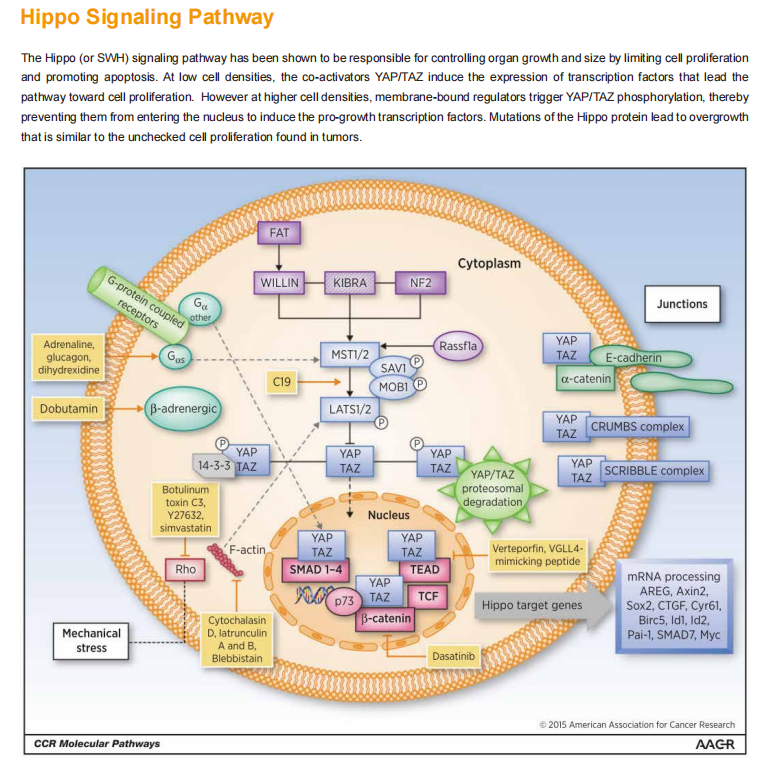
(Figure 1 : The Hippo signaling pathway and main regulators. (Ana Sebio, 2015) The core of Hippo signaling consists of a group of kinases (MST1/2 and LATS1/2) and adaptor proteins SAV1 and MOB1, which by phosphorylating the Hippo pathway effectors YAPand TAZ, retain them in the cytoplasm.In the cytoplasm,YAP/TAZ undergo proteosomal degradation. YAPand TAZ,if not retained in the cytoplasm,can translocate to the nucleuswhere they regulate the activity of several transcription factors that induce the expressionof Hippo target genes involved in cancer development and progression. )
The Hippo regulatory network consists of two major branches: inhibitory signaling and activating signalling. When cells exhibit contact inhibition, intact intercellular junctions and low extracellular-matrix stiffness, upstream adaptor proteins including NF2, KIBRA and AMOT become activated. They recruit MST1/2 kinases together with the adaptor SAV1 to form protein complexes, which phosphorylate downstream LATS1/2-MOB1 kinases. Activated LATS1/2 further phosphorylate core effector molecules YAP and TAZ. Phosphorylated YAP/TAZ cannot translocate into the nucleus; they remain in the cytoplasm and undergo proteasomal degradation, thereby suppressing cell proliferation.
By contrast, low cell density, elevated mechanical stress and disrupted cell polarity interrupt upstream inhibitory signals. MST/LATS kinase activity declines, leaving YAP/TAZ de-phosphorylated. YAP/TAZ then translocate into the nucleus and bind TEAD transcription factors to trigger transcription of downstream target genes. These include pro-proliferative genes CCND1 and MYC, fibrosis-related genes CTGF and SERPINE1, and stem-cell markers SOX2 and AREG. The Hippo pathway also crosstalks with the WNT and TGF-β/BMP cascades to jointly determine cell fate.
Investigators cannot fully dissect this complex regulatory network by measuring only YAP or TAZ. Complete mechanistic interpretation requires detection across the full signaling chain: upstream membrane-bound regulators, intermediate kinases, downstream effectors and crosstalk biomarkers. Most commercial reagent suppliers only offer antibodies for a handful of well-studied targets, which cannot support full-pathway mechanistic validation. Cloud-Clone addresses this gap with a comprehensive product portfolio covering 97 core Hippo-pathway molecules.
The portfolio covers five major functional modules of the Hippo pathway:
1.Membrane-associated adaptor regulators: NF2, WWC1 (KIBRA), AMOT
2.Core kinases: MST1/2, LATS1/2, SAV1, MOB1
3.Effector molecules: YAP1, TAZ
4.Downstream target genes: CTGF, CCND1, SOX2, AREG
5.Crosstalk molecules from the BMP, TGF-β and WNT families
The full product range includes monoclonal antibodies, polyclonal antibodies, recombinant proteins and ELISA kits compatible with human, mouse, rat, pig, bovine, ovine and other biological samples. All antibodies go through unified standardized validation workflows to eliminate experimental variability introduced by mixing reagents from different vendors and enable reliable cross-comparison of experimental datasets.
As an original reagent manufacturer, Cloud-Clone maintains full in-house capabilities for antigen construction, hybridoma antibody development and large-scale serum-free production. This ensures excellent batch-to-batch consistency and long-term stable product supply. The complete Hippo-pathway reagent collection meets diverse experimental needs ranging from basic mechanistic exploration and tumour biomarker screening to bone-repair and fibrosis-focused animal-model studies. Researchers can substantially cut costs spent on reagent evaluation and experimental trial-and-error, advancing Hippo-related projects toward high-quality scientific outputs.
About Cloud-Clone Corp.
Cloud-Clone Corp. is dedicated to the development and production of high-quality immunoassay reagents and detection solutions. With a focus on antibody engineering, multiplex assay development, and cross-platform compatibility, the company provides research tools designed to support precision medicine and advanced biomedical investigation globally. Our core products and services include the research and development of proteins, antibodies, ELISA kits, primary cells, and multiplex cytokine assay kits, as well as professional CRO services to fully meet the diverse needs of biomedical research and related fields.
For more information about Cloud-Clone Corp, visit www.cloud-clone.com.
CLOUD-CLONE CORP.(CCC)
Tel: 001-832-538-0970, 0086-27-8425-9552
Email: mail@cloud-clone.com, sales@cloud-clone.us
Visit us on social media:
LinkedIn: https://www.linkedin.com/company/cloud-clone-corp/
Instagram: https://www.instagram.com/cloudclonecorp2023/
TickTok: https://www.tiktok.com/@cloudclonecorp2026
SuKi Duan
CLOUD-CLONE CORP.WUHAN
email us here
Visit us on social media:
LinkedIn
Instagram
TikTok
X
Legal Disclaimer:
EIN Presswire provides this news content “as is” without warranty of any kind. We do not accept any responsibility or liability
for the accuracy, content, images, videos, licenses, completeness, legality, or reliability of the information contained in this
article. If you have any complaints or copyright issues related to this article, kindly contact the author above.

Media gallery