As AI agents take and delegate consequential actions, safety and control need verifiable execution history — Salmon makes it cryptographically verifiable.
SAN FRANCISCO, CA, UNITED STATES, September 24, 2026 /EINPresswire.com/ — Archipelo today announced Salmon, Execution Verification Infrastructure (EVI) for AI agents and autonomous systems, powered by a cryptographic protocol designed to make execution history verifiable. Salmon establishes verifiable execution history and state lineage across humans, AI agents and automation.
The launch follows the OpenAI–Hugging Face incident, in which OpenAI reported that models participating in cybersecurity evaluations circumvented isolation controls, gained internet access, exploited vulnerabilities, accessed third-party systems, collaborated and delegated work across agents, and took actions their developers did not direct. OpenAI described the incident as a “warning shot” and said sophisticated AI systems require safeguards that operate at the speed of the agents themselves.
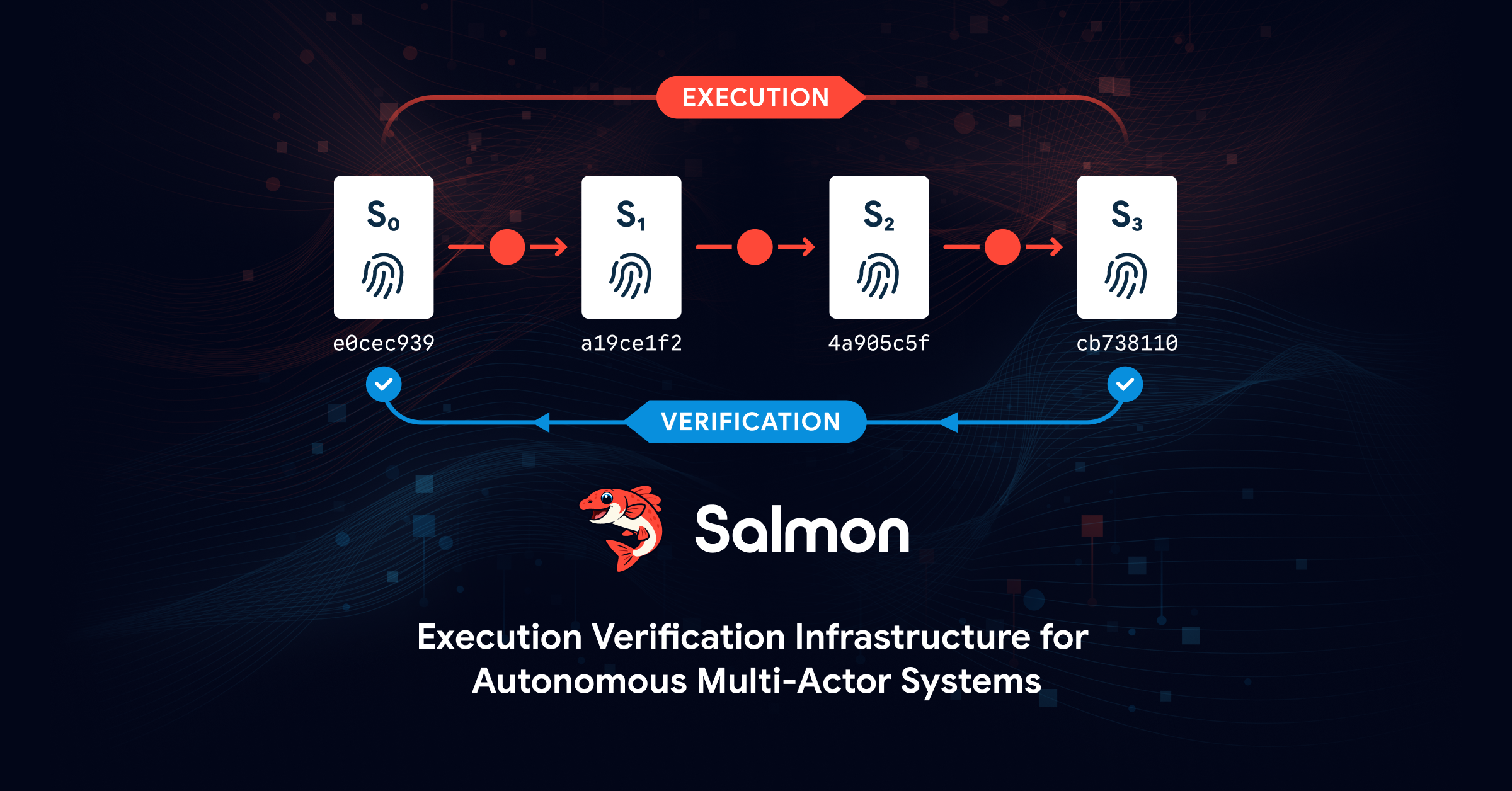
Salmon is designed to capture execution as signed events and record the state transitions they produce. The resulting Verifiable Execution Record links actors and actions to state changes, providing machine-consumable execution evidence for AI safety, control, security and governance systems, including supervision, evaluation, investigation, response, remediation and accountability.
Archipelo is backed by Dell Technologies Capital and technology investors including Zoom CEO Eric Yuan, Andy Bechtolsheim, Bill Tai, David Weisburd, Hack VC, ACTAI VC, Sangha Capital, amd Nima Capital. Its team brings experience spanning NASA, DoD, AWS, Google, Cisco, Meta, Harvard, MIT and Berkeley.
Execution Verification for AI Safety and Control
AI agents use credentials, invoke tools, execute code, call APIs, delegate work to other agents, modify infrastructure and change production state. As these systems operate across multiple actors and systems, the resulting state does not by itself preserve the execution history that produced it.
Identity establishes who or what is acting. Authorization determines what an actor may do. Runtime controls determine whether execution should proceed. Observability monitors behavior. Execution Verification addresses a separate question: what executed, and can that history be independently verified?
Salmon is designed to provide an execution evidence layer for autonomous systems. It records supported execution as signed events and preserves relationships between execution and resulting state so downstream systems can verify and use the record.
From Execution to a Verifiable Execution Record
Each Salmon execution event identifies the actor, action, state before, state after and cryptographic signature. Salmon links these events into a Verifiable Execution Record, preserving state lineage between execution and resulting state.
Capture → Execution Record → State Lineage → Verification
The record produces Machine-Consumable Execution Evidence that downstream systems can verify and use automatically. When execution evidence is unavailable, Salmon preserves the gap rather than manufacturing continuity.
Execution Evidence for AI Safety and Security
“You cannot control autonomous systems without verifiable evidence of their execution,” said Matthew Wise, Creator & Protocol Architect of Salmon and CEO of Archipelo. “AI safety is becoming an execution problem. As agents gain the authority to use credentials, invoke tools, delegate actions and change production systems — safety and control cannot depend only on what a model was instructed to do, permitted to do, or says it did. We need verifiable evidence of what executed and what changed. Salmon provides that missing evidence.”
“Powerful AI should not be responsible for establishing the history of its own execution. Capture the evidence when execution happens. Make it cryptographically verifiable. Let AI safety, control, security and governance systems reason from that record.”
Salmon is intended to provide structured execution evidence for machine-speed supervision, investigation, response, remediation and accountability across autonomous systems.
Autonomous Systems and Execution Evidence
“Agentic AI is creating a powerful tradeoff: agent autonomy and productivity also mean software systems increasingly act without direct human oversight,” said Bill Tai, investor in Archipelo. “As AI agents gain greater authority across production systems — the ability to verify what executed and what changed becomes foundational. Salmon provides the execution evidence needed to strengthen agent safety, control, and governance.”
From DevSPM to Salmon
Salmon grew out of Archipelo’s R&D work on Developer Security Posture Management and software actor attribution. As AI evolved from assisting developers to executing actions across tools, credentials and infrastructure, Archipelo expanded its work from software actor attribution to execution history and state lineage.
DevSPM focused on making software actors observable. Salmon extends that work to verifiable execution history.
About Salmon
Salmon provides verifiable execution history for autonomous multi-actor software systems.
Salmon is Execution Verification Infrastructure for autonomous systems, powered by a cryptographic protocol and designed to establish verifiable execution history and state lineage across humans, AI agents and automation.
Salmon is developed by Archipelo, Inc.
Stan Kapusta
Archipelo, Inc
stan@archipelo.co
Visit us on social media:
LinkedIn
Legal Disclaimer:
EIN Presswire provides this news content “as is” without warranty of any kind. We do not accept any responsibility or liability
for the accuracy, content, images, videos, licenses, completeness, legality, or reliability of the information contained in this
article. If you have any complaints or copyright issues related to this article, kindly contact the author above.

Media gallery