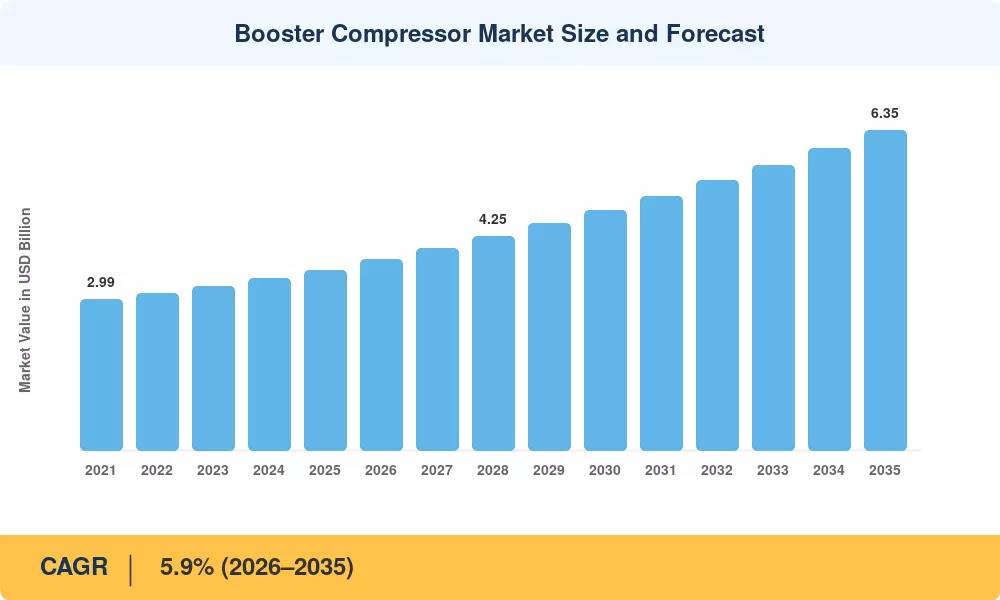
Booster Compressor Market is projected to grow from USD 3.79 billion in 2026 to USD 6.35 billion by 2035, registering a CAGR of 5.9%
NEW YORK, NY, UNITED STATES, August 24, 2026 /EINPresswire.com/ — As Per the MRFR Analysis, Booster Compressor Market is projected to grow from USD 3.79 billion in 2026 to USD 6.35 billion by 2035, registering a CAGR of 5.9% during the forecast period 2026 to 2035, driven by Integration of advanced automation technologies.
Market Overview
The Booster Compressor Market encompasses specialized equipment designed to increase the pressure of gases for various industrial applications, including natural gas transmission, hydrogen refueling, manufacturing processes, and food and beverage production. These compressors are critical components in midstream pipeline operations, petrochemical complexes, and emerging clean energy infrastructure, enabling efficient gas transport, storage, and utilization across diverse end-user sectors.
Capital spending on natural gas transmission infrastructure, tighter federal efficiency standards from the U.S. Department of Energy [1], and accelerating hydrogen refueling station deployments are the primary catalysts anchoring this growth trajectory. Operators across midstream pipelines, petrochemical complexes, and food-processing plants are prioritizing pressure-amplification equipment that meets evolving emission thresholds while delivering measurable energy savings. The global LNG liquefaction capacity is on track to reach 800 MTPA by 2030, up from roughly 480 MTPA at end-2024, according to the International Gas Union [7]. Each new liquefaction train requires booster compression to maintain feed-gas pressure, while regasification terminals use high-pressure booster compressor units to inject gas into onshore grids.
A generational technology shift is reshaping the Booster Compressor Market. Legacy fixed-speed reciprocating units are giving way to variable-speed drive systems that cut parasitic energy losses by 15–25%, according to the Compressed Air and Gas Institute [2]. The European Union’s Ecodesign Directive revision for industrial compressors, expected to take full effect by 2027, mandates minimum isentropic efficiency levels that will effectively retire pre-2015 designs across the bloc [3]. Global compressor OEMs have collectively earmarked over USD 1.2 billion in R&D spending through 2028 to develop oil-free, digitally monitored platforms capable of operating at pressures above 350 bar for hydrogen and specialty-gas applications. The integration of advanced automation technologies, including IoT sensors, AI-driven predictive maintenance, and digital twin platforms, is enabling operators to achieve 20–30% reductions in unplanned downtime and 8–12% energy savings [12].
Get Free Sample Report for Detailed Market Insights:
https://www.marketresearchfuture.com/sample_request/31571
Market Segmentation
By Cooling Type
The Booster Compressor Market is segmented into Air-Cooled and Water-Cooled systems. Air-cooled systems captured approximately 62% of the market share in 2025, reflecting their lower installation complexity and suitability for remote upstream facilities [4]. These units eliminate the need for cooling-water infrastructure, which is often impractical at remote pipeline stations, offshore platforms, and arid-region facilities. Water-cooled configurations are forecast to expand at a 7.1% CAGR through 2035, gaining traction in continuous-duty petrochemical and hydrogen compression applications where sustained duty cycles above 85% utilization require effective thermal management to protect seal life and volumetric efficiency.
By Compression Stage
The market serves Single-Stage, Two-Stage, and Three-Stage and Above compression designs. Single-stage units hold approximately 54% share in 2025, serving the largest volume segment in the market by handling moderate pressure-ratio duties in CNG refueling and general industrial air systems [2]. Two-stage systems account for USD 0.89 billion in 2025, supporting midstream gas gathering and refrigeration applications. Three-stage and above compression designs are advancing at a 7.6% CAGR through 2035, driven by high-pressure hydrogen refueling and ultra-deep gas recovery projects. Hydrogen dispensing at 700–900 bar and CCUS applications at 150+ bar both require sequential compression with intercooling to stay within material stress limits, making multi-stage configurations essential for emerging clean energy applications [8][10].
By Lubrication Type
The Booster Compressor Market is divided into Oil-Lubricated and Oil-Free systems. Oil-lubricated units hold approximately 65% share in 2025, reflecting cost efficiency and broad industrial base [4]. Oil-free systems are the fastest-growing segment at a 7.4% CAGR through 2035, gaining adoption wherever product contamination is unacceptable—food and beverage CO₂ recovery, pharmaceutical nitrogen supply, and hydrogen fueling where even trace oil can poison fuel-cell catalysts. While oil-free units carry 20–35% higher purchase prices, they eliminate lubricant consumption, oil-carryover filtration, and contaminated-condensate disposal costs, often achieving total cost of ownership convergence within 5–10% over a ten-year lifecycle for continuous-duty applications.
By Pressure Range
The Booster Compressor Market serves 21 to 40 Bar, 41 to 100 Bar, 101 to 350 Bar, and Above 350 Bar pressure ranges. The 21–40 bar pressure range remains the dominant segment with 47% share in 2025, fueled by widespread demand for compressed natural gas distribution and general industrial plant air boosting [7]. The 101–350 bar range is expanding at a 7.2% CAGR through 2035, driven by hydrogen storage and diving-gas supply applications. The above 350 bar segment stands out as the fastest-growing pressure range at a 7.9% CAGR, propelled by global clean energy initiatives requiring high-pressure hydrogen fueling and storage infrastructure, with Germany’s H2Global initiative and Japan’s revised hydrogen strategy calling for 1,000 refueling stations by 2030, each requiring at least one high-pressure booster compressor rated for 900 bar service [8][16].
By End User
The Booster Compressor Market serves Oil and Gas, Manufacturing, Food and Beverage, and Others (healthcare, mining, marine, data centers). The oil and gas sector held roughly 34% of the market in 2025, underpinned by midstream transmission, gas-gathering, and LNG boil-off gas recovery [7]. Manufacturing accounts for USD 0.68 billion in 2025, driven by automation, pneumatic tools, and process gas requirements. Food and beverage end users are pacing the field at an 8.0% CAGR through 2035, propelled by CO₂ recovery systems, modified-atmosphere packaging, and cold-chain expansion, particularly across Southeast Asia and Latin America [15].
You can buy this market report at:
https://www.marketresearchfuture.com/checkout?currency=one_user-USD&report_id=31571
Regional Analysis
Asia-Pacific
Asia-Pacific dominates the Booster Compressor Market with approximately 42% of global revenue in 2025 and is set to maintain the fastest regional growth at 7.3% CAGR through 2035. China leads with 46% of regional share, driven by the West–East pipeline program and petrochemical build-out [9]. The National Energy Administration approved 8,600 km of new long-distance gas pipelines in 2024 alone, each requiring intermediate booster stations spaced every 100–150 km. India follows with a 7.8% CAGR through 2035, with the Petroleum and Natural Gas Regulatory Board targeting 100% geographic coverage of city-gas distribution by 2030, translating into thousands of CNG compression installations nationwide [23]. Japan contributes USD 0.19 billion in 2025, driven by hydrogen refueling station mandates, while South Korea follows with a 7.1% CAGR, supported by its hydrogen economy roadmap and shipbuilding LNG programs. ASEAN nations are channeling over USD 120 billion into petrochemical and refining capacity between 2025 and 2032, per the ASEAN Centre for Energy [9].
North America
North America holds about a 24% share of the Booster Compressor Market, buoyed by LNG export terminal construction along the U.S. Gulf Coast and shale-gas processing demand. The United States dominates with 78% of regional share, driven by LNG export terminals and CCUS pilot projects [7]. The U.S. alone approved four new LNG export facilities between 2023 and 2025, collectively representing over USD 45 billion in capital investment, and each project specifies multi-stage compression packages rated above 100 bar [7]. The Inflation Reduction Act’s 45Q tax credits for carbon capture have unlocked over USD 10 billion in announced CCUS investments since 2023, each requiring multi-stage compression for CO₂ transport [10]. Canada follows with 14% of regional share, supported by oil-sands gas processing and hydrogen hubs, with its Clean Hydrogen Investment Tax Credit offering up to 40% of eligible costs [22].
Europe
Europe accounts for roughly 21% of the Booster Compressor Market, with growth underpinned by hydrogen backbone planning and industrial decarbonization mandates. Germany leads with a 6.8% CAGR through 2035, driven by H2Global imports and industrial decarbonization [16]. Germany’s Federal Network Agency has approved over 9,700 km of hydrogen-ready pipeline corridors, and compression stations along these routes will need to handle pressures up to 100 bar [16]. The UK contributes USD 0.11 billion in 2025, supported by North Sea gas tail-end recovery, while France and Spain follow with nuclear-powered hydrogen production and solar hydrogen corridors respectively [18]. The European Commission’s industrial decarbonization roadmap aims for a 50% decrease in direct fossil-fuel use by 2040, steadily reducing the pool of available gas-handling equipment while hydrogen and biogas applications counter some displacement [18].
South America
South America holds 7% of the Booster Compressor Market, with Brazil dominating at 68% of regional share. Brazil’s market is anchored by Petrobras’s USD 102 billion 2024–2028 strategic plan, which allocates significant spending to deepwater gas processing where high-pressure compression is essential [24]. Argentina follows with a 5.8% CAGR, driven by Vaca Muerta shale gas development, while the Rest of South America contributes through agribusiness and mining support applications.
Middle East & Africa
The Middle East & Africa region holds 6% of the Booster Compressor Market, with Saudi Arabia leading at 38% of regional share. Saudi Aramco’s Jafurah unconventional gas program, targeting 2 billion scf/d by 2030, will require extensive compression infrastructure [25]. The UAE follows with a 6.5% CAGR through 2035, driven by ADNOC sour-gas processing, while Egypt’s Eastern Mediterranean gas hub and Mozambique’s LNG projects represent significant growth corridors [7].
Competitive Landscape / Key Players
The Booster Compressor Market exhibits moderate concentration, with the top five players accounting for an estimated 38–44% of global revenue [14]. Key players include Atlas Copco, Ingersoll Rand, Siemens Energy, Ariel Corporation, Bauer Compressors, Howden (Chart Industries), Kaeser Kompressoren, Sundyne, Maximator GmbH, and Corken (IDEX Corporation) [14].
Atlas Copco leads with an estimated 8–11% revenue share, offering oil-free and oil-injected boosters with IoT-enabled monitoring as a global full-line leader with a strong aftermarket network. Ingersoll Rand follows with 7–10% share, providing reciprocating and rotary boosters and a rental fleet with a broad industrial portfolio and servitization focus [21]. Siemens Energy holds 5–8% share, offering centrifugal and reciprocating packages for pipeline and LNG applications with an integrated energy-systems approach. Ariel Corporation commands 5–7% share, specializing in separable reciprocating compressors for gas transmission as the dominant player in North American midstream compression. Bauer Compressors holds 4–6% share, focusing on high-pressure breathing air and gas boosters to 500 bar as a niche leader in ultra-high-pressure and hydrogen-ready units [8].
Strategic developments in the industry include the U.S. Department of Energy’s January 2024 publication of final compressor test-procedure rules under 10 CFR 431, establishing minimum isentropic efficiency levels effective January 2027 [1]. The European Commission adopted Ecodesign Lot 31 implementing measures for industrial compressors in October 2023, mandating Tier 2 efficiency thresholds from 2028 [3]. Compressor OEMs are embedding vibration, temperature, and pressure sensors that feed cloud-based analytics dashboards, with Atlas Copco and Ingersoll Rand both launching subscription-based remote-monitoring services in 2024 [21].
Latest Industry News & Developments
U.S. Department of Energy (January 2024): Published final compressor test-procedure rules under 10 CFR 431, establishing minimum isentropic efficiency levels effective January 2027 [1].
European Commission (October 2023): Adopted Ecodesign Lot 31 implementing measures for industrial compressors, mandating Tier 2 efficiency thresholds from 2028 [3].
Global CCS Institute (2024): Reported that over 390 CCUS projects are in various stages of development worldwide, with combined capture capacity targeting 360 MTPA by 2030, creating growing demand for multi-stage booster compression [10].
Market Challenges & Opportunities
Challenges
The Booster Compressor Market faces several notable challenges. High upfront capital and installation costs represent a significant restraint, with a multi-stage booster compressor package rated for 200+ bar service carrying a fully installed cost of USD 250,000–750,000, depending on materials, controls, and ancillary cooling systems [14]. For small and mid-sized operators—particularly in South America and sub-Saharan Africa—this capital intensity delays procurement decisions and tilts demand toward refurbished or rental equipment.
Supply-chain bottlenecks for specialty alloys pose another constraint, with hydrogen-tolerant compressor components requiring austenitic stainless steels and nickel-based superalloys that have lead times of 38–52 weeks in 2023–2024, compared to a pre-pandemic standard of 18–24 weeks [17]. The industry continues to be vulnerable to periodic tightness in the supply chains for nickel and cobalt as the battery and aerospace sectors compete for the same raw materials. Electrification displacing gas-fired processes, skilled-technician shortages for maintenance, and regulatory permitting delays for new facilities further challenge market growth.
Opportunities
Significant opportunities exist in the Booster Compressor Market. Hydrogen compression as a premium growth vertical presents a transformative opportunity, with over 40 nations having published national hydrogen strategies by 2025 [8]. OEMs who invest early in oil-free diaphragm and ionic-liquid piston technologies will be able to capture premium margins, with certification constraints limiting the number of new entrants. The market for 450–900 bar compression platforms is small but growing fast, driven by Japan’s 1,000 refueling station target and Germany’s EUR 4.4 billion H2Global import infrastructure allocation [8][16].
Rental and leasing platforms lower entry barriers, with global revenues from rental of compressed-air and gas equipment exceeding USD 4 billion in 2024, growing at approximately 9% annually [14]. Digital twin and predictive-maintenance monetization presents a margin expansion pathway, with OEMs embedding sensors that feed cloud-based analytics dashboards [21]. CCUS and enhanced oil recovery demand creates a growing end-use vertical, with over 390 CCUS projects in development worldwide requiring CO₂ compression to supercritical transport pressures above 100 bar [10]. Emerging-market industrialization in Southeast Asia and Africa offers volume opportunities, with ASEAN nations channeling over USD 120 billion into petrochemical and refining capacity between 2025 and 2032 [9].
To explore more market insights, visit us at:
https://www.marketresearchfuture.com/reports/booster-compressor-market-31571
Final Market Summary
The Booster Compressor Market is poised for steady growth, projected to expand from USD 3.79 billion in 2026 to USD 6.35 billion by 2035, at a CAGR of 5.9%. This expansion is fundamentally underpinned by natural gas transmission and LNG infrastructure expansion, the hydrogen economy and refueling station rollout, and energy-efficiency regulations that mandate replacement cycles. Asia-Pacific maintains its dominant position, while North America and Europe follow with significant investments in LNG export terminals and hydrogen backbone planning. Technological innovation, including variable-speed drive systems, oil-free designs, and digital twin platforms, is reshaping the competitive landscape, enabling operators to achieve measurable energy savings and reduced downtime. The market’s long-term potential remains strong, supported by the convergence of decarbonization policy, corporate ESG commitments, and emerging opportunities in hydrogen compression, CCUS, and rental platforms, ensuring booster compressors’ critical role in industrial gas handling and clean energy infrastructure through 2035 and beyond.
More Related Reports from MRFR Library:
Reciprocating Compressor Market: https://www.marketresearchfuture.com/reports/reciprocating-compressor-market-8351
Offshore Cranes Market: https://www.marketresearchfuture.com/reports/offshore-cranes-market-8445
Solar Hybrid Inverter Market: https://www.marketresearchfuture.com/reports/solar-hybrid-inverter-market-8452
Industrial Gearbox Service Market: https://www.marketresearchfuture.com/reports/industrial-gearbox-service-market-8524
Geothermal Power Market: https://www.marketresearchfuture.com/reports/geothermal-power-market-8731
Hydraulic Power Unit Market: https://www.marketresearchfuture.com/reports/hydraulic-power-unit-market-8768
Diesel Genset Market: https://www.marketresearchfuture.com/reports/diesel-genset-market-9541
Hydraulic Components Market: https://www.marketresearchfuture.com/reports/hydraulic-component-market-9985
Building Integrated Photovoltaics Market: https://www.marketresearchfuture.com/reports/building-integrated-photovoltaics-market-10013
Battery Recycling Market: https://www.marketresearchfuture.com/reports/battery-recycling-market-10020
Larry Wilson
WantStats Research And Media Pvt. Ltd.
+ +1 855-661-4441
email us here
Visit us on social media:
LinkedIn
Facebook
YouTube
X
Legal Disclaimer:
EIN Presswire provides this news content “as is” without warranty of any kind. We do not accept any responsibility or liability
for the accuracy, content, images, videos, licenses, completeness, legality, or reliability of the information contained in this
article. If you have any complaints or copyright issues related to this article, kindly contact the author above.

Media gallery