
Workers Are Adopting AI Faster Than Their Employers Are Guiding Them, New Study Finds
PR Newswire
NEW YORK, Aug. 10, 2026
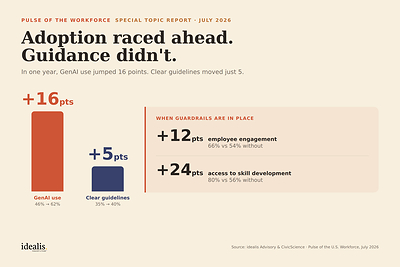
GenAI use among U.S. workers is up 16 points in a year. The share of companies with clear guidelines for using it has barely moved.
NEW YORK, Aug. 10, 2026 /PRNewswire/ — Generative AI (GenAI) use among U.S. workers has climbed to 62%, up 16 percentage points from last year, according to idealis’s ongoing tracking of the U.S. workforce. But the guidance meant to accompany that use has not kept pace: only 40% of workers say their company has clear GenAI usage guidelines in place. The findings come from a follow-up wave of the research-backed leadership advisory firm’s 2025 study, with a nationally representative survey powered by CivicScience of more than 15,000 workers conducted over the last several months.
The gap is unlikely to close on its own. Among workers who already use AI, 72% report concern about their own job security, compared with 46% of those who don’t use AI yet, a sign that familiarity is sharpening anxiety rather than easing it. And most leaders are already adopting the technology: 76% use GenAI at work, compared with 61% of non-leaders. That makes setting clear guidelines a leadership choice rather than a knowledge problem.
Where those guidelines exist, the payoff shows up quickly. Employees at organizations with clear GenAI guidelines report higher engagement (66% versus 54%) and far greater access to skill development (80% versus 56%) than those without.
“Adoption was never going to be the hard part for AI at work,” said Dr. Sumona De Graaf, Founder and CEO of idealis. “The technology is accessible and widely useful to a broad range of jobs, professions and industries. The hard part is setting the guardrails, providing training, and earning trust from the top, so that people feel guided rather than left to figure it out on their own. The organizations that already have clear AI guidelines in place are experiencing a workforce that is ready and motivated to learn, try and embrace the tools available to them. That’s the case for leaders to step up now, not later.”
Additional findings:
62% of workers now use GenAI professionally, up from 46% a year ago, while 78% remain concerned about AI’s impact on jobs, essentially unchanged from last year.
Financial services (86%), education (85%), information and professional services (75%), and health services (69%) lead all industries in adoption.
Hispanic/Latino (76%), Black (83%), and Asian (83%) workers report using AI at work at higher rates than white workers (55%).
De Graaf sees a deeper pattern beneath the numbers. “AI doesn’t invent an organization’s problems, and it won’t solve them on its own. It amplifies what is already there,” she said. “Where trust or clear expectations are missing, AI exposes the fault lines first. Where the foundation is strong, it reveals that too.”
For a deeper look at the findings, idealis CEO Dr. Sumona De Graaf and her team unpack the data and what it means for leaders in a free, on-demand webinar.
About idealis
idealis is a research-backed leadership advisory firm that helps organizations navigate moments of change with clarity, trust, and a belief that high performance and high humanity are inextricably linked. “Ready or Not, It’s Here: AI Adoption at Work” is the July 2026 edition of its Pulse of the Workforce, conducted in partnership with CivicScience. The full report is available by request at media@idealisadvisory.com.

 View original content to download multimedia:https://www.prnewswire.com/news-releases/workers-are-adopting-ai-faster-than-their-employers-are-guiding-them-new-study-finds-302846663.html
SOURCE Idealis Advisory


