
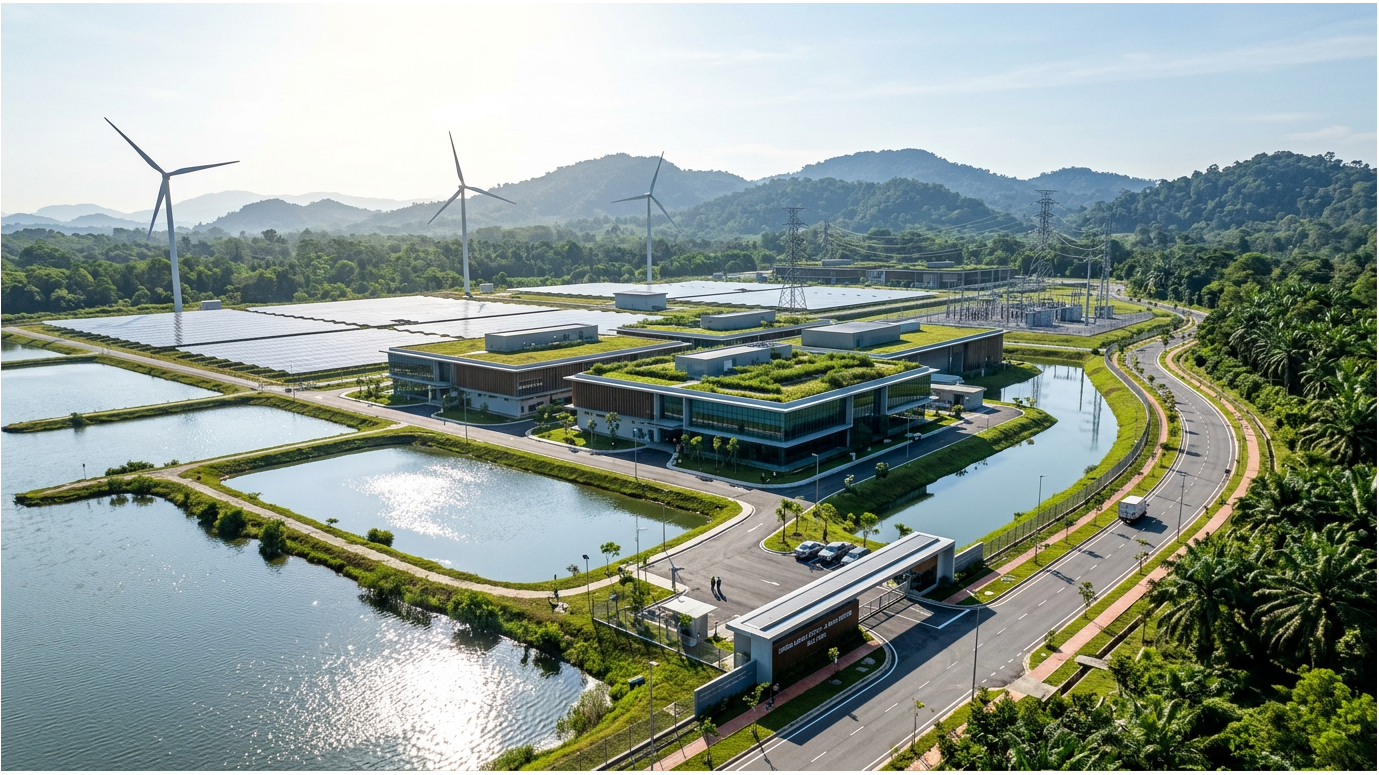
Five prime land plots at Sungai Samak Estate in Tanjong Malim, Malaysia, are being presented as global data centre strategy enters a more demanding phase shaped by energy pressure, cooling requirements, geopolitical risk, and the search for resilient industrial locations.
Artificial intelligence has accelerated the need for compute infrastructure, but the sector is now confronting the physical limits of rapid expansion. Large data centres require stable electricity, dependable cooling water, grid access, backup systems, and land for future upgrades. The challenge has become so intense that space-based data centre concepts have attracted attention as a possible long-term alternative.
Yet orbital computing remains largely an ideation story rather than an immediate solution. Every server, solar panel, radiator, and communications system would still need to be manufactured on Earth and launched into space. Maintenance would become a space systems problem, obsolete equipment could become orbital debris, and the full lifecycle emissions of manufacturing, launch, operation, and disposal remain unresolved. For the foreseeable future, AI infrastructure must be built responsibly on land.
This is where Sungai Samak Estate enters the investment conversation. Located in Tanjong Malim and connected to Malaysia’s Automotive High Technology Valley, the estate offers five plots that may support AI data centre facilities, renewable-integrated infrastructure, advanced manufacturing, and industrial technology uses.
The opportunity is also relevant because data centres have become geopolitical assets. Financing decisions are increasingly influenced by data sovereignty, tenant identity, China-US tensions, cybersecurity concerns, and regulatory screening. Some investors now weigh whether a tenant, operating model, or jurisdiction could trigger future political or financing complications. In that environment, transparent site planning and long-term infrastructure fundamentals matter more than speculative growth claims.
China and the United States illustrate the scale of the challenge. The US is attempting to meet demand through private hyperscaler investment, expanded gas generation, solar and wind projects, battery storage, nuclear restart plans, and grid optimisation. However, permitting delays, transformer shortages, labour constraints, local resistance, and water concerns continue to slow execution.
China has pursued a more coordinated approach, using central planning to move compute capacity toward western regions with stronger power availability, cooler climates, and access to renewable energy. Its large grid, transmission infrastructure, and battery storage capacity give it advantages, although demand remains enormous.
Both markets show that successful data centre locations will be judged by energy resilience, water access, cooling efficiency, land availability, and operational adaptability.
Sungai Samak Estate’s five plots are positioned for developers and investors seeking a Malaysian platform aligned with those priorities. The location’s proximity to EV manufacturing, industrial automation, and technology-led production adds another layer of relevance as compute and manufacturing become increasingly interconnected.
Further information is available at https://sgsamak.com. Parties interested in land details, planning discussions, or partnerships may contact the estate team through https://sgsamak.com/contact-us.
Sungai Samak Estate offers a timely land opportunity in a market where AI demand is rising, but only well-planned, resource-conscious data centre sites are likely to endure.
Sungai Samak Estate
2 Jalan Sempurna off Jalan Gombak
Kuala Lumpur
Federal Territory
53000
Malaysia


