
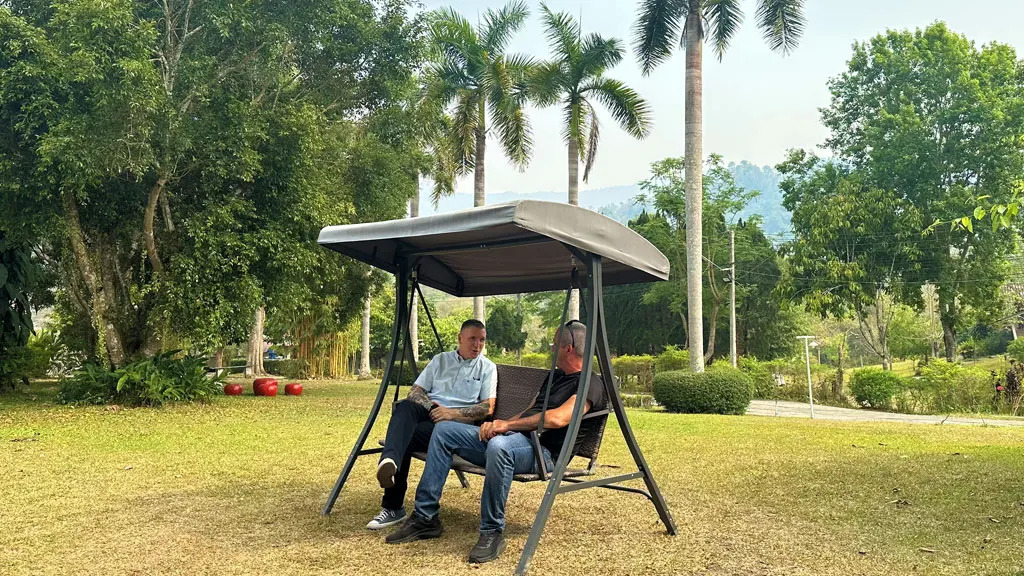
Edinburgh, Scotland Aug 10, 2026 (Issuewire.com) Siam Rehab, a licensed private residential treatment facility in Chiang Rai, Thailand, has built its programme around a structure that is, by design, unusual: no 12-step curriculum, no group-based framework, and a hard cap of 18 residents at any given time. The model is drawing a growing number of enquiries from Scotland, where access to specialist treatment varies significantly depending on where in the country someone lives.
Public Health Scotland’s most recent quarterly figures show the national standard, that 90% of people referred for drug or alcohol treatment should wait no more than three weeks, was met overall in the final quarter of 2025. Five NHS Boards did not meet it: Tayside came in at 88.2%, Highland at 84.2%, Lothian at 83.2%, Western Isles at 81.0%, and Shetland at 80.0%. For someone weighing options in one of those areas, a facility with no waiting list at all changes the calculation.
“We hear from families in Scotland who’ve done the maths on their own NHS Board’s figures before they ever call us,” said Wade Dupuis, Managing Director of Siam Rehab. “Nobody should have to time their crisis around a postcode. That’s really the gap we sit in: we’re not competing with the NHS, we’re an option for people who’ve looked at the wait and decided they can’t wait.”
Treatment at Siam Rehab is built on cognitive behavioural therapy, motivational interviewing, dialectical behaviour therapy, and a treatment plan drawn up individually for each client rather than assigned by a standard curriculum. Keeping capacity at 18 clients keeps the numbers tight throughout: a staff-to-client ratio of roughly 1:1.3, and a counsellor-to-client ratio of roughly 1:4-5.
Alcohol remains the single largest category among Scotland’s community-based treatment referrals, ahead of drug-related referrals, a pattern Public Health Scotland’s data has shown consistently across recent quarters even as overall referral volumes have moved up and down. Dupuis noted that alcohol cases often arrive later than drug cases, sometimes after years of a person and their family managing things privately before anyone reaches out for formal treatment.
Admission starts with a single assessment call, used to confirm the person is clinically suited to residential treatment. From there, because Siam Rehab’s own capacity is rarely the constraint, a placement can usually be arranged quickly, with no waiting list on the facility’s end. On site, a psychiatric clinic runs seven days a week, and every client leaves with a written aftercare plan built with their primary counsellor, covering relapse-prevention steps, medication or psychiatric follow-up where relevant, telehealth scheduling, and links to support resources back home.
The clinical team includes on-site counsellors, a licensed clinical psychologist, and an external psychiatrist who runs on-site clinic hours weekly alongside telehealth availability. For clients coming from Scotland and the rest of the UK, intake coordination is handled in part through Siam Rehab’s Europe-based advisor network, so initial contact and paperwork can happen without the client needing to deal directly with Thailand at that stage.
Founded in 2014, Siam Rehab has now operated in Chiang Rai for over a decade.
About Siam Rehab
Siam Rehab is a licensed private residential addiction treatment facility located in Chiang Rai, Thailand, operating under Can Siam Co., Ltd. The facility is jointly accredited by Thailand’s Healthcare Accreditation Institute (HAI) and the National Institute for Drug Abuse Treatment and Rehabilitation (NISAD), Department of Medical Services, for the period 20 May 2026 to 19 May 2029. A European office in the Netherlands supports clients across Scotland, the rest of the UK, and continental Europe.
Media Contact
Siam Rehab
+66 979436477
109 Moo 12 Patueng, Mae Chan District
Source :Siam Rehab
This article was originally published by IssueWire. Read the original article here.


